
All guides
Architecture
This page is the map: what the pieces are, which way the arrows point, and which seams are
contracts. It is deliberately readable on its own — the picture below illustrates it, it does not
carry it, because the terminal cannot show you a picture and an agent reading nxs guide deserves
the same account you get.
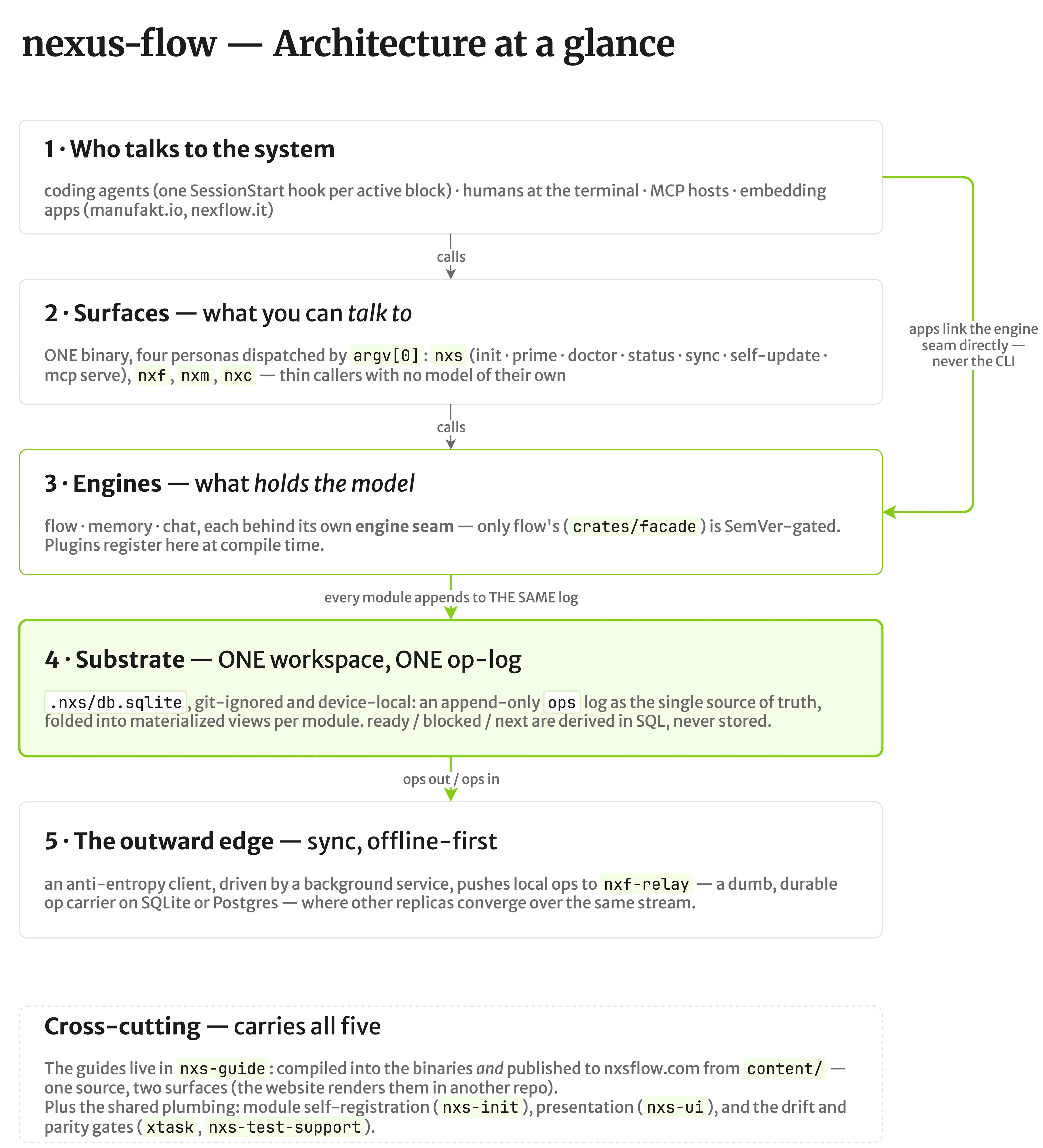
The rendered diagram is on this topic's page at
nxsflow.com/open-source/docs#develop-architecture; in a terminal you are reading the text version,
which says the same thing.
Five layers, top to bottom
1 — Who talks to the system. Coding agents (each active block installs its own SessionStart hook), humans at a terminal, MCP hosts, and embedding apps like manufakt.io and nexflow.it.
2 — Surfaces. ONE binary, four personas dispatched by argv[0]: nxs is the umbrella
(init, prime, doctor, status, sync, self-update, mcp serve), and nxf, nxm, nxc
are the three blocks. They are thin callers — no surface holds a model of its own.
3 — Engines. flow, memory and chat, each behind its own engine seam. Only flow's
(crates/facade) is a SemVer contract; the other two are seams without that promise yet. Plugins
register here at compile time, which is how a consumer supplies a vocabulary the open-source
engine never ships.
4 — Substrate. One workspace, one log. .nxs/db.sqlite is git-ignored and device-local, and
an append-only ops table inside it is the single source of truth. Every module appends to THE
SAME log.
5 — The outward edge. An anti-entropy client, driven by a background service, pushes local ops
to nxf-relay — a dumb, durable op carrier on SQLite or Postgres — where other replicas converge
over the same stream. The server stores and hands back ops; it never folds, derives or validates.
Two arrows are worth naming on their own. An embedding app links the engine seam directly and never shells out to the CLI — the app and the CLI are equals over one core, which is why every CLI verb has a counterpart on the seam. And the substrate arrow runs one way only:
ops (append-only) → fold → materialized views → derivationnxf next and nxf blocked are computed in SQL over the views, never stored. That is what
keeps the work list consistent no matter which order ops arrived in — and it is why merging two
replicas cannot produce a board that disagrees with itself.
What the picture does not show
Two things, and both are deliberate.
It is a building-block view: it says what the parts are and which way they call each other, not what happens over time. Everything above is the map; none of it is the trip — and the trip has its own page: the journey of one operation follows a single verb from the surface down to the log and back up to an answer nobody stored.
And it is coarse at crate level: six blocks for a crate map of fourteen. nxs-foundation, the
sync client's internals, the background service that drives it, and the relay's storage backends
are all folded into the band that owns them rather than drawn.
For the layer you actually need next: the workspace says what nxs init
leaves on disk, and modules says which block to reach for.